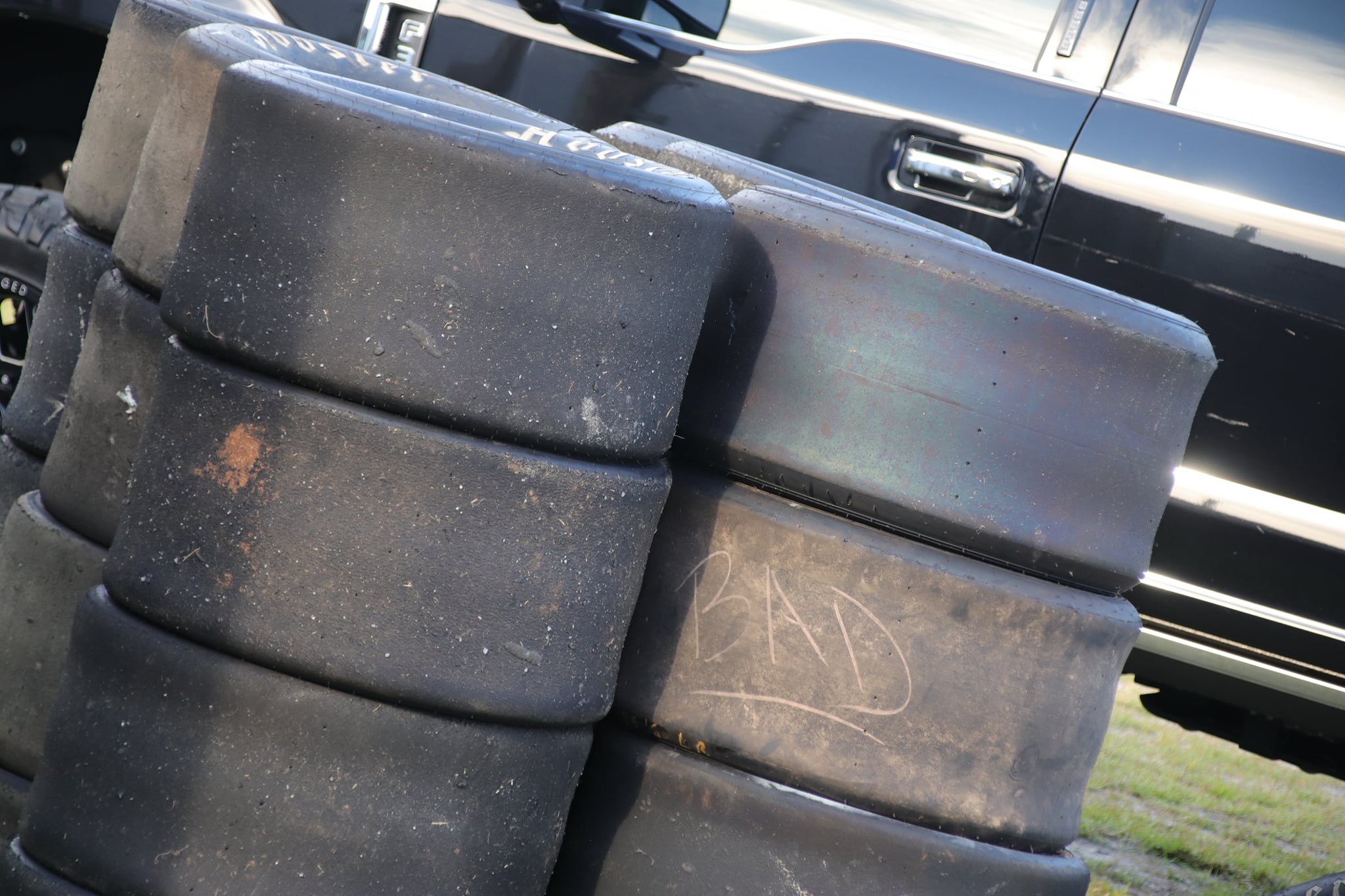
Racetracks in the southeast are continuing to struggle with the ongoing tire shortage with more tracks canceling races or being forced to take Late Model Stock Cars off their schedule while others are shifting to scuff tire programs to get by.
North Carolina’s Ace Speedway and Tennessee’s Kingsport Speedway have each scrapped Late Model Stock Cars from their Friday night racing programs for the upcoming week citing an inability to acquire new Hoosier F45 tires – though both tracks say they hope to get tires in the coming weeks.
“In hopes that more tires will be available in the near future, Late Model Stocks will be moved to our August 20th date for The Prelude to the Rodney Cook Classic,” Ace Speedway said in a statement on Facebook. “This will give a number of other teams time to repair cars from wrecks and/or have extra time to dial in setups.”
Ace Speedway had recently changed to a two-tire program, where teams purchase two new tires instead of four and run a pair of scuff tires on the left side – tires which are usually impounded by the track after each event.
Kingsport Speedway hopes to be able to run Late Model Stock Cars next Friday night.
“We have tried to acquire more F-45 for you to be able to purchase for Friday night’s event. We are unable to do so,” Kingsport’s statement read. “We have discussed several different scenarios and cannot fill the needs that are suitable and fair for everyone for Friday night’s Late Model event. In not being able to do so we will not be running Late Models this Friday, Aug 6th. We are staying in contact with Hoosier and are in hopes we will have tires by our Aug 13th event. We will keep everyone up to date on what is transpiring.”
Tri-County Speedway has once again postponed its racing program due to the tire shortage.
“We regret to inform you that due to lack of receiving tires we will be rescheduling our Aug. 7th race to Aug. 14th,” Tri-County Speedway said in a statement. “This shortage is beyond our control. We are doing everything we can to resolve this issue. The Freeman Family/Hoosier South is doing everything in their power to help with these shortages. We wanted to get this information to all our racers and fans ASAP so they could make other plans for the weekend. Once again we are sorry for any inconvenience we have caused. Hope to see everyone on the 14th.”
While some tracks have been forced to cancel races, others are adjusting their Late Model rules.
Florence Motor Speedway in South Carolina will be implementing a scuff tire program beginning with their next race on Saturday night.
“If you have previously raced with us and have tires here in impound you will only have to purchase 2 “New To You” tires (A-scuffs),” the track said in its Facebook post. “If you have not raced with us you will have to buy 4 “New To You” tires (A-Scuffs). If you have raced with us and have tires in impound that didn’t meet the minimum lap count as everyone else you will need to run them within your two 10 minute practice sessions. If you decide that is too much to accomplish you will have the choice to purchase 2 more “New To You” tires (still A-scuffs).”
Virginia’s Franklin County Speedway and North Carolina’s Goodyear All American Speedway already run scuff tire programs for their Late Models – Franklin County on Hoosier scuffs and Goodyear All American Speedway on American Racer scuffs.
Limited supply, increasing demand
The ongoing tire shortage has been the dominant story in Late Model Stock Car racing in 2021.
Back in May, both Hoosier and American Racer had been urging tracks and teams to be cautious with their tire supplies. Some tracks have heeded the warnings, though the demand for new tires remains high among racers – especially demand for practice tires in a discipline that has cultivated a seemingly unsustainable testing culture.
In years past, it was not unusual for teams, most notably in the Solid Rock Carriers CARS Tour, to rent tracks for testing multiple days a week, racking up exuberant tire bills. Facing declining attendance and car counts, tracks have become more entrenched in the tire selling business as a source of revenue.
The current testing culture has placed even more demand on tire manufacturers as teams take to tracks in pursuit of any competitive or technological advantage they can find. As a result, more and more budget-conscious drivers have been driven out of competition in asphalt racing and either made the move to dirt or quit altogether.
Both Hoosier and American Racer have cited the increasing demand from racers as a key contributing factor to the shortage.
“We’re producing more tires than we ever have in the history of the company and our employees are working six days a week, 24 hours a day,” Irish Saunders, asphalt business manager for Hoosier Racing Tire, said in an interview with Short Track Scene in May. “However, if I’m being honest, I have no idea where the hell everything is going because car counts aren’t through the roof. Talking to tracks that sell tires, they got guys who are coming in and, instead of buying four or eight tires, give me 16 or give me 24 right now.”
Saunders elaborated more on the practice culture and how the racers themselves should be more flexible.
“The Tri-County deal, obviously everybody read about Tri-County, you know what I don’t understand? They cancel races, right, but they’re still gonna do a practice,” Saunders stated in the May interview. “That doesn’t make sense. If you can’t get tires, and people say they’re out of tires, it’s not that they’re out of tires, some people say they’re out, but it’s the sizes you get. A guy might say, ‘hey I’ve got to have a six and a quarter, right, and all you have is six or six and a half, they say, ‘well I can’t run on those.’ It’s a quarter inch, that’s two pounds of air. That’s all you’re dealing with here. That’s some of it. But some of it is that guys are overbuying.”
Hoosier has been trying to ration tires to make sure tracks can get tires, but is struggling to keep up with the demand.
“We’re trying to ration and make sure everyone is taken care of but we are going to run out of tires if people keep buying at this rate,” Irish Saunders, asphalt business manager for Hoosier Racing Tire, said. “Take what you need.”
American Racer said in May that they were worried about being in a similar position with tire shortages.
“Racers are mobile,” Scott Junod, director of racing for American Racer, said. “They can move around. If a racer wants to go race and he can’t race at track x for whatever reason, rainout, no fuel or tires, whatever that problem is, that racer can go to racetrack y because they can race there… we’re going to see racers come over to our tracks and it will increase the demand on our products.”
Resistance to scuff tire programs
When Goodyear All American Speedway opened in Eastern North Carolina in July, the track instituted a scuff tire program, purchasing used tired from both Dominion Raceway and Jennerstown Speedway, while hoping and waiting to purchase new tires by the end of the year.
However, scuff tire programs have always met resistance.
In 2014, prior to a Limited Late Model race at Southern National Motorsports Park which was run only on scuff tires, then-track champion Haley Moody said, “I don’t like it, nobody does.”
Despite the concerns many drivers had then about a scuff tire Late Model race at Southern National, a healthy 24 car field took the green flag in the race, which saw Joey Throckmorton win over Clay Jones and Haley Moody.
The sentiment toward scuff tires from many racers can be summed up as, “I don’t want to put an expensive race car on junk tires.”
Despite the concerns about scuff tires, Goodyear All American Speedway’s opener on Saturday night saw 14 drivers take the green flag – a strong field in a region where other nearby tracks have recently seen car counts in the mid-range of the single digits.
While many drivers are vocal in their opposition to scuff tire programs, there are plenty who are fine with them and a growing number who have accepted that scuff tire races may be the only way some regional tracks, such as Florence Motor Speedway, can complete the season as Hoosier will now find itself having to supply tires to racetracks for season-ending majors, such as the ValleyStar Credit Union 300, Winchester 400 and Snowball Derby.
While the demand from racers is a driving force behind the tire shortages, other issues, such as a shrinking labor force and supply chain issues, continue to persist. While job growth is slowly rebounding, new concerns are arising, such as the spike in COVID-19 cases and hospitalizations which itself has already prompted additional race cancelations and could again strain supply chains and labor participation.
Those very same labor participation and supply chain issues have also put a strain on race teams and parts suppliers. Parts shortages have not yet resulted in a crisis-level impact on short track racing but remain just one more challenge for racers during an ongoing global emergency.
Short Track Scene’s Brandon White contributed to this report.
Read more Short Track Scene: