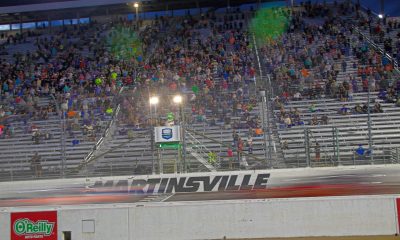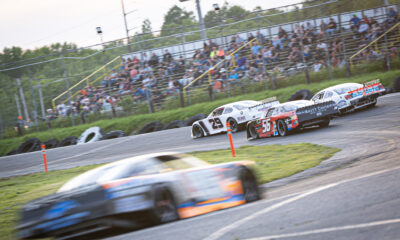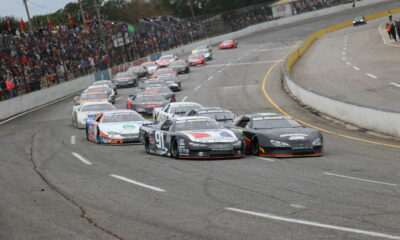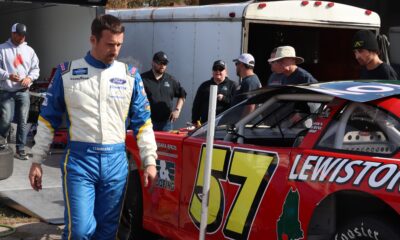
For four years, Maine race fans have held out hope that angels might sweep in to save Beech Ridge Motor Speedway.
But any angels that deign to descend upon the town of Scarborough will have arrived too late.
Demolition of the 77-year-old facility commenced this week, returning Beech Ridge to dust and preparing the site for its next calling. It’s the final, somber chapter in the history of a speedway that was, for so many, a family member that grew along with them.
But last July, tenured supporters of the dormant speedway penned an epilogue, one final guaranteed moment for the Beech Ridge community to gather and eulogize the track they once called home.

For 73 years, Beech Ridge Motor Speedway thrived as part of Maine’s racing ecosystem. Originally a dirt track that catered to Maine’s stock car and Modified fanatics, the third-mile oval was paved in the late 1980s. Under the stewardship of the Cusack family, generations of racers and fans forged memories and built legacies at Beech Ridge.
But at the season-ending awards ceremony in 2021, owner Andy Cusack announced that he had sold the property for redevelopment, and the just-completed season would likely be its last.
There was no warning. There were no outward signs. Even track announcer and emcee Andy Austin was in the dark, left to entertain a crowd that needed to be consoled.
One last afternoon of racing was hastily pulled together by track employees, giving Beech Ridge’s racing family a rushed sendoff before the gates were locked for good.
The next April, an auction cleared the speedway grounds of the accoutrements and relics that kept it, in fans’ eyes, a turnkey race track. In the ensuing years, Beech Ridge’s future remained shrouded in uncertainty. Fans investigated whether they could petition Maine to declare Beech Ridge a state historical site. Rumors swirled of what the property could become, of buyers backing out only for new suitors to emerge.

Many held out hope that there could be a path that led to Beech Ridge reopening for competition, much as Unity Raceway emerged from its own travails across the state. But it was not to be.
The shuttered speedway on Holmes Road taunted both those who drove past daily, as well as those who took pains to avoid it. Then, last year, an opportunity came about to unlock the gates again.
Last spring, a group of speedway supporters reached out to the current owners of Beech Ridge, seeking permission to welcome fans for one last visit before the track’s demolition. The new ownership agreed, paving the way for a Beech Ridge reunion.

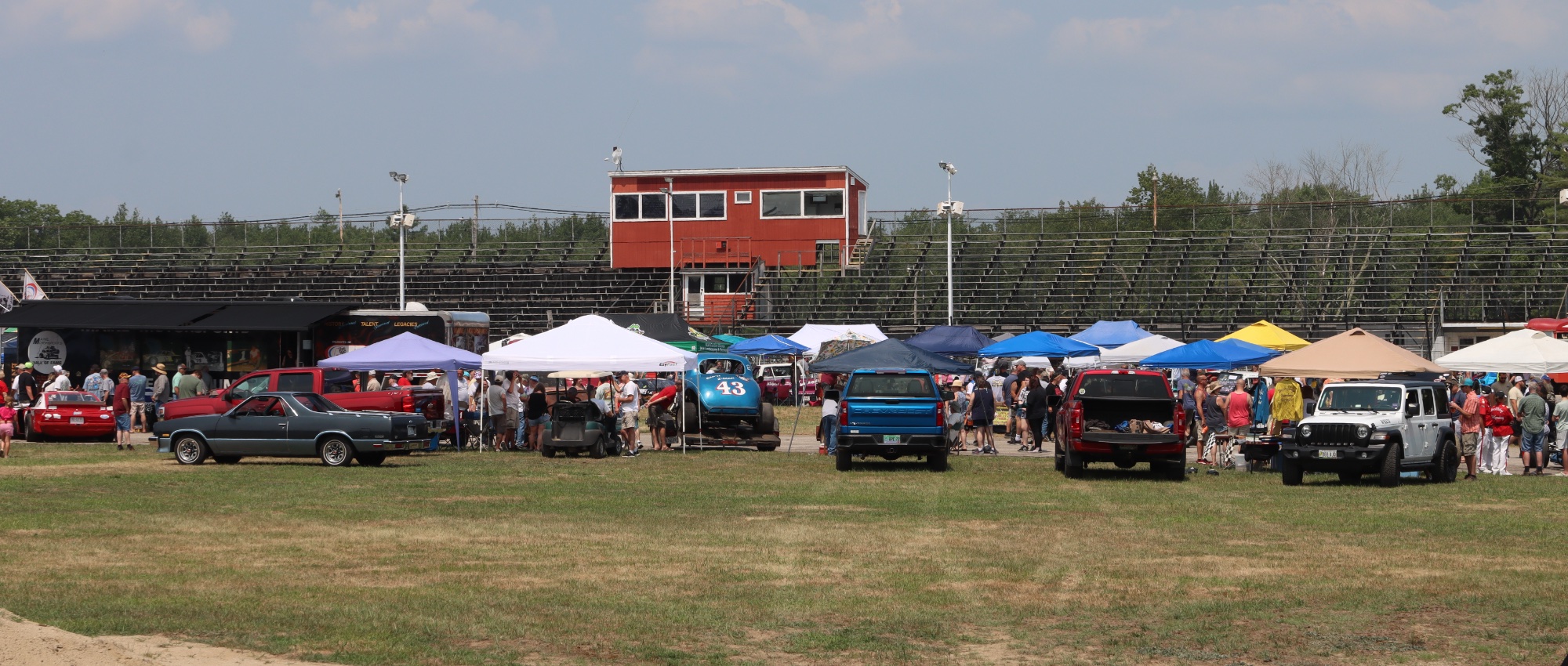
Longtime Beech Ridge pit steward Dan Walker and Andy Jones, in cooperation with the Maine Vintage Race Car Association, organized a mid-summer car show to be held at Beech Ridge. On Sunday, July 28, the speedway would open to the public one last time, showcasing race cars from the extensive collections of MVRCA members as well as those of current racers who had once called Beech Ridge home.
Walker and Jones were granted access through the summer to clean up the neglected grounds, making the track suitable for visitors. And on July 28, for five hours, the speedway gates opened up again.
For that final afternoon, the racing community that once supported Beech Ridge Motor Speedway was able to walk the grounds of the shuttered speedplant to bid their final farewells.
Some came seeking closure. Others sought catharsis. Some compared it to taking selfies with the casket at a funeral. Others questioned if they could even face the emotions of stepping through the gates.
But for an afternoon, those personal feelings were set aside in search of community.
That community was only a few short steps through the ticket gates, under and out of the steep frontstretch grandstands, and down the stairs by the flagstand onto the frontstretch itself. The efforts of Walker and Jones to clean up the speedway grounds were on full display; despite years of neglect and some key missing artifacts, Beech Ridge looks ready for opening day.
Encircling the racing surface are race cars culled from tracks and tours around Maine and coastal New Hampshire, most tracing their lineage or their history to Beech Ridge in some way.

Staged on the apron of turn one is Gary Smith, the final driver to claim a Pro Series championship at Beech Ridge. Smith’s short-lived Northeast Pro Stock Association, or NEPSA, was a crucial bridge between the demise of the American-Canadian Tour Pro Stock sanction in 1995 and the Pro All Stars Series that emerged in 2001. The Bangor, Me. racer owns another key Beech Ridge “last,” winning the final PASS Super Late Model event held in 2018.

Smith is joined by a number of other Pro Series graduates: multi-time Beech Ridge and Oxford Plains Speedway track champion Dave Farrington, Jr., Lee USA Speedway track champion Brandon Barker, and rising talent Dalton Gagnon have their cars on display as well.

Brandon Johnson, another of the speedway’s final champions, is stationed in turn four with his street stock. The final champion of Beech Ridge’s Mad Bomber Varsity division, Johnson has since moved up the ladder and settled into a new rhythm at Oxford. Dean Hanscom, one of Johnson’s Mad Bomber rivals, is parked nearby with an orange Ford Crown Victoria that draws inspiration from the orange Fords of regional legend “Dynamite” Dave Dion.
Sport Series racer Colby Meserve’s new ACT Late Model is tucked under a canopy on the backstretch, with a selection of Legends cars, PASS Modifieds, and Sportsman cars parked along the painted wall. No class of cars, from four-cylinder mini stocks to the icons of Beech Ridge’s “Car Wars” thrill shows, goes unrepresented.
One car missing from the cadre of Beech Ridge alumni is that of Super Late Model racer Evan Beaulieu. Beaulieu is at the track this afternoon; his car sits in his Durham, Me. shop, race-worn from a sixth-place finish in Friday’s Granite State Pro Stock Series feature.
Beaulieu, his wife Lindsey, and their young daughter Millie are strolling through the speedway grounds. It’s Millie’s first and last glimpse of a place that means so much to her parents.

Never mind the years Beaulieu spent racing go-karts, Legends and eventually stock cars around Beech Ridge. It was also where he took Lindsey for their first date.
“Lindsey and I talked about hanging out, and my only thought was Beech Ridge,” Beaulieu recalls. “Years later and here we are with a family because of that place.”
It was at that place that Evan and father Todd, both merely race fans, learned how to be racers. Evan would pick up a number of wins along the way, capped by a Pro Series victory in 2013.

“I have so much to be thankful for in my time there,” he says. “I still race with and see so many people that were there from my first go-kart races there. A lot of the people I still race with, I grew up with at Beech Ridge. There’s about a few dozen of us that were either in go-karts, Thursday Thunder, whatever it was, that we are all extended family because of our connection to Beech Ridge.”
Beaulieu was at the final race the track hosted in 2021, and there were conflicted emotions as he returned in 2024.
“It was like attending a funeral twice,” Beaulieu reflected the following day. “We had already said our goodbyes, I already made my final lap there. I already smoked the tires down the front stretch that last night. But my daughter wasn’t born then, and to have her at least get to go to the place that was so special to not only me, but for both Lindsey and I, was special.”

Yet Beaulieu found himself craving more. “It does upset me knowing how good a shape the track is still in,” he says. “We could’ve been racing there [Sunday], we could’ve had events there the last three years.”
Instead, Beaulieu has found a traveling home with the GSPSS after testing the touring waters in 2021. He is adapting to the challenge of new and disparate venues. But Beech Ridge’s closure left a void that no single track was suited to fill.
“Beech Ridge was our home track,” he says. “I don’t know where I’d consider my home is now.”
Beaulieu reflects on some of the rumored possibilities for the track’s redevelopment. Beaulieu and his wife are entrepreneurs; he understands the business case for the sale. But his heart has another opinion.
“Theres nothing that land is good for,” he says, “except a race track.”

A crowd walks up and down the infield pit road, where the MVRCA has set up its own display of vintage race cars. The MVRCA’s mobile museum trailer is staged in the middle, surrounded by race cars representing years of Maine and New England racing history.
The museum and the cars recall the heroes who built legacies at Beech Ridge, drivers like Dick Wolstenhulme, Homer Drew, Rick Zemla and Dick McCabe. A Supermodified campaigned by Ralph Cusack sits alongside one driven by Bob Timmons, the first of three racing Timmonses.

The relics give way to oddities, like a “superspeedway modified” once driven by Ray Hendrick and restored two decades ago by hot-rodder and former Beech Ridge racer George “DoDo” Brockman. Framed copies of magazine articles outline Brockman’s ordeal in restoring the late-’70s conversation piece to a condition in which it could once again take to the Daytona high banks.

Two slots down from Brockman’s superspeedway modified sits another Maine curiosity, a mid-1990s ARCA SuperCar Series Chevrolet Monte Carlo raced by Scarborough’s Joe Bessey. A successful competitor on the NASCAR Busch North Series circuit, Bessey moved to the national-level Busch Series in 1993. Bessey also fielded an entry in the ARCA season finale for three years, finishing third in 1994 and second in 1995.
In 1996, sporting Alan Kulwicki’s No. 7 and sponsored by Pennsylvania-based electricity broker Power Team, Bessey won a shortened General Tire/Hoosier 500K. The partnership with Power Team propelled Bessey to a 1997 Busch Series win at Dover and eventually to a role as a NASCAR Cup Series team owner for driver Geoffrey Bodine.

Across pit road, there are more cars from racing’s relatively-modern era. A sleek white-and-blue Buick showcases the signature livery of Maine-based pipeline company Everett J. Prescott, Inc., who sponsored dozens of race cars throughout the 1980s and 1990s. The Buick was raced in 1988 by Newburgh’s Ricky Craven on his way to a driving and broadcasting career at NASCAR’s national level. Next to Craven’s Buick is a lovingly-restored Sportsman-class Pontiac for veteran Pete Silva.

Also among the “newer” vintage cars on display is a NASCAR Busch North Series Chevrolet for four-time series champion Andy Santerre. The paint scheme recalls Santerre’s fourth and final championship season, when he raced for car owners Steve and Peg Griswold.
“That was a Grizco car,” Santerre explains, “and we ended up selling that to [sponsor] Castle, who’s on the hood of the car. They’ve had that car since 2011, when I ran the Rev Racing diversity program. Rev had bought that from the Grizco team, and we had that for four or five years, and we sold it as a show car, and it’s basically on loan from Castle.”
Santerre was one of Maine’s national prospects in the 1990s, sprinting up the ladder in a career that took him as far as NASCAR’s Busch Series’ victory lane. He returned to the Busch North Series in 2002, winning four straight titles before phasing into a role as a team owner and driver coach. Santerre’s team, rechristened Revolution Racing and later Rev Racing, became NASCAR’s official diversity development program.

Santerre’s hometown of Cherryfield is a four-hour drive from Beech Ridge, but he has fond memories of the track from his youth.
“My dad loved dirt racing, and obviously Beech Ridge was the last dirt track in the state of Maine,” he says. “So every year in September for my birthday, my dad would take me to Beech Ridge for my birthday. We’d ride his motorcycle, I’d ride on the back, probably from the time I was eight years old until I got too cool for it when I was probably a teenager.
“We’d come down every year and sit in the bleachers and watch the races. And my dad would always point out [Dick] Wolstenhulme and [number] P38, Homer Drew. He’d say, ‘Those guys are fast.’ Because my dad had been here and raced in the ‘60s, and he said, ‘Aw, I couldn’t run with those guys,’ he says, ‘those guys are crazy fast.’ But they were set up for this track, you know? And Dad would just come down and wing it, you know?
“But he loved this track. Fortunately my dad got to see me win twice here, so that was cool. We’d come every year and enjoyed it.”

Following a bout with Guillain-Barré syndrome, Santerre breezed through the American-Canadian Tour in its Pro Stock era, then the Busch North Series, which first visited Beech Ridge in 1995.
“And then obviously when I got to the Busch North Series, and was able to get here for the first time, it was a cool deal, even though it was asphalt then,” Santerre recalls. “I won the second year I think I came here with the Busch North car, ‘96, I won, and then I won again here in 2003 when I was driving for Joe Bessey, in the No. 6 Aubuchon car. So a lot of history here, and a lot of good times.”

In eleven stock car starts at Beech Ridge, Santerre finished sixth or better in eight of them.
“I won my first ACT Tour last-chance qualifier [at Beech Ridge],” he adds. “It was actually the first race that I had run. Come here and beat Glenn Cusack by inches to get into the last-chance race, and that was in 1991! That was my first time around the track.”
The Busch North Series ran its last race at Beech Ridge in 2003. Santerre wound down his stock car driving career two years later. But when the NASCAR Whelen Modified Tour returned to Beech Ridge in 2021, Santerre was there once again, this time as a fan.
“I was here that night,” he remembers, nodding. “I sat in the grandstands.”
Santerre has just come from another longer interview with the Black Flagged Podcast. To the right of the flagstand gate, the popular regional podcast is recording on location, speakers broadcasting their conversations with Santerre and local racer Jerry Babb to a small crowd. An edited version will be uploaded Monday night.
Hosted by local racers and superfans Charlie Sanborn III, Bradley Saucier and Bobby Timmons III, the Black Flagged Podcast blends local racing news, interviews, and candid accounts of the trio’s experiences in motorsports. At times authoritative, but more often irreverent, the show has struck a chord with a broad audience across the country.
Some listen because they relate to the hosts. Some listen because they live vicariously through them.

“I had met Bradley at Oxford Plains Speedway, during the Oxford 250 weekend,” Sanborn explains. “I had taught him how to eat a lobster; he didn’t know how to do it. So that’s how we had become friends. We had known each other about a year or so, and it all started with just a message. It was actually his idea, the concept of the show. He’s like, ‘You’re the only person I know that I would trust with a microphone. Is this something you’d be interested in?’”
Sanborn and Saucier were the original hosts. Timmons joined the program early on as a guest, eventually settling into a full-time role aside from a one-year hiatus.
“Our first show quite literally had seven listens,” says Sanborn of the early days. “It’s blown up into something with, y’know, 13,000 followers on Facebook, and hundreds of thousands of downloads, I think we’re over half a million at this point. It’s crazy how it’s blown up, but again, it wouldn’t exist without this place.”

The model for the podcast is the Turn 5 Tavern, the now-vacant trackside pub tucked between turn four and the main road.
“We were fortunate enough to have the Turn 5 Tavern,” Sanborn says. “You’re having a couple brewskis with your pals, and you’re having a conversation. Well, we just wanted to replicate that conversation, but just hit record on it. We’ve done almost 300 shows, done a couple live events, a main event at a bar. We just got to talk to the one and only Andy Santerre. It’s presented a lot of opportunities that would never have happened if this place didn’t exist.”
All three hosts have raced at Beech Ridge. Saucier’s tenure at the wheel was brief, cut short by a lack of funding. Timmons’ career took shape at Beech Ridge, but his racing dreams soon outgrew what Beech Ridge could offer.
For Sanborn, though, Beech Ridge carries a far deeper significance.

“My dad grew up, he went to California, he was in the military,” Sanborn recalls of his father Chuck. “By the time he had run his course in the military, he told my mom, ‘I kind of want to go home.’ He’s from Cape Elizabeth. I was two years old, three years old at the time.
“The day that we got here, we had driven 3000 miles all the way from Mission Viejo, California to Scarborough, Maine, and my dad raced a Legend car that night here. So the joke was always, we drove 3000 miles for him to race ten.”
The elder Sanborn moved into Beech Ridge’s Wildcat division. “It was a red, white and blue No. 23,” Sanborn remembers, “because his dad was a parts and service representative for American Motors. The ‘23’ was because his birthday was December 23rd. He had had a brand made up in his mind before he even got here. He got to fulfill a boyhood dream in doing that.”

But as Chuck saw that dream taking hold in his son, he stepped back. “I actually spent two years, from the time I was five until I was seven, going around, collecting bottles and cans, going to my grandmother’s neighborhood, getting some of her stuff,” he recalls. “It took me two years, but I saved up enough to buy my first go-kart. And that was something I did that was completely on my own.
“We bought our first go-kart, it was a used piece, and we started right here, right here on the frontstretch at Beech Ridge Motor Speedway. We ran the short course, through turns one and part of the frontstretch, and down in the infield. It was something that we did every Friday. We were here.”
For several years, Sanborn honed his skills in karting while his father’s old Wildcat sat derelict in the woods. “Towards the end of it, we were out of money,” he says. “But that car was still sitting out there. We were here on PASS 400 weekend one year, we were just spectators, and Matt Hodgdon was out there in the parking lot between turns one and two. He goes up to my dad and asks him, ‘Do you still have that old Wildcat?’ ‘Yeah, yeah, Charlie would never let me sell it.’ So he’s like, ‘Why don’t we turn it into a Mad Bomber?’

“We quite literally peeled that thing out of the woods. Took two trees out of it, had to cut a tree out of the floorboard … we had made some changes, but it had been enough time where a Mad Bomber was basically what a Wildcat used to be.
“We got it roadworthy, for the most part, and that’s how I started my full-size car career.”
The teenaged Sanborn adapted quickly to the Mad Bomber, and an opportunity came about to acquire a Limited Sportsman, what Beech Ridge dubbed the Sport Series. “My father was good friends with George Libby,” he says. “George had that silver 55 car, it was a Pontiac, and my grandfather was a Pontiac mechanic before he was an AMC parts and service rep. So everything was just kind of melding together.”
George and Chuck made a handshake deal to buy the car. “To speak on George Libby’s character, when that car went on to win the championship in 2010 with Chris Smith behind the wheel, people were coming up to George and offering him more money,” Sanborn remembers. “He said, ‘No, I shook the man’s hand, I can’t go back on that.’ That’s how we ended up with my Limited.”

Sanborn called the Sport Series home for nearly a decade. “I was the redheaded kid that nobody had ever heard of,” he says. “But I’d lived down the street my whole life. I’d heard the sounds and sights every Saturday, always wondering what was going on over there, and wanting to be there. Once we ran that Limited, I did it pretty much by myself. My dad got me to the point where he gave me the tools and the resources, but after that, he didn’t know a steering wheel from a screwdriver, for the most part.”
Once again, Sanborn was a quick study. “We won rookie of the year in 2011. We won the biggest race of the year the following year, the Budweiser 100. I was actually the youngest ever to win the Budweiser 100. I wasn’t old enough to get the trophy. They had to put it on the ground and I had to go get it, because they couldn’t transfer an alcohol product to a minor!”

College plans put Sanborn’s full-time racing on pause in 2013, but he returned home, both to Maine and the Sport Series. Then, in the heat of the COVID-19 pandemic, an opportunity came together to purchase a Super Late Model from Austin Theriault.
“Fast forward to 2021,” he says, “and I was fortunate enough to run a Super Late Model here. And that was always the dream. That was a really emotional day, for sure. We got to run the Granite State race, after running the PASS race down in Hickory. But I wanted to run here. This was home. This was what it was all about.”

Beech Ridge and its community, after all, were at the center of Sanborn’s coming-of-age story.
“This is a place that taught not only myself, but a lot of people, how to be a man,” Sanborn says. “You know what I mean? This is where I partially learned how to drive a standard. This is partially where I learned how to date and meet people, how to fight for myself and stick up for myself, how to have tough conversations with people who are older than you and more experienced than you. It also teaches you how to admit, ‘hey, I fucked up.’ That’s a life skill that myself and a lot of people wouldn’t have if this place had never existed.
“It’s helped mold and shape a lot of human beings.”
And the quality of the on-track product only enhanced that.
“For those who never got to experience it,” Sanborn says, “this place had very much its own vibe, its own characteristics, the sights, the sounds, the smells. Andy Austin on the microphone, and the way that the program was run. It was very much a show, and you knew that you were part of the show, and you knew that you were important, and you were putting on something that was pretty special every single week.”

Sanborn planned to run for Pro Series Rookie of the Year honors in 2022, something he had discussed with former track owner Cusack earlier in the year.
That all changed only a few weeks later.
“The fact that that was all kind of ripped away from us, the way that it was, I think was the hardest part about it,” he muses. “Maybe not that it happened, but how it happened, I think is what’s tough for a lot of folks. It was just bizarre, very bizarre the way it all went down. I’ll admit, I was one of those folks where I didn’t know if this was something I was gonna be comfortable with. Because we’re three years removed at this point, maybe I’d kind of put it in the rear view.
“I was one of the little kids dreaming of maybe even owning this place,” he says. “It was just a hare-brained idea. It was never a possibility that it could go away. And I think that that’s what’s sad.”

Sanborn is buoyed by the crowd before him, proud that the track that shaped his life gets one final moment to shine.
“This is obviously a really special event,” he says. “Huge shoutout to Dan Walker, and the Maine Vintage Race Car Association, and Andy Jones. They spent months getting this place just presentable. It was important to make it look the way that it always looked. If, hopefully not, but if this is the last time we all get to be here, it looks right. The old girl has done her job.”
The show is a sendoff many tracks never get to have, one that seemed doubtful back in 2021.
“It’s a huge turnout,” he continues. “I’m incredibly proud to be just a very, very, very small part of it.”
And in a twist of fate, Beech Ridge presented Sanborn with a parting gift.

Not long after the track’s closing, Sanborn connected with Lindsey Walker at a social engagement. Sparks flew. Sanborn and Walker quickly became partners, and in the summer of 2023, the couple welcomed Charles Sanborn IV, informally “Chase,” to their family.
In every phase of Sanborn’s life, Beech Ridge Motor Speedway has somehow played a part.
“It’s wild,” Sanborn says. “If this place didn’t exist, I quite literally wouldn’t have the little family that I’m so proud to have. I’m Charles III, and Charles IV exists because of this place. It’s incredibly sad that he’ll never get his day here, [that] he’ll never get to understand what we all got to do and experience, and the reason for his existence. That’s what’s crazy to me.
“But this is also the place that presented me with an opportunity to get invited to go some place, and that’s how I met the love of my life, and the mother of my baby. It’s all just kind of gone from there.”
Walker has her own complicated history with Beech Ridge. Her father Dan, a lifelong track employee, is the former pit steward who helped organize this reunion. Her brother Jeff was a weekly racer at Beech Ridge; Jeff’s son has started a racing career of his own. But Walker never called the track home in the same way her family did.
“It was definitely different,” she says. “I grew up here similarly to a lot of people in racing. But I was the little sister and the daughter, and I never, for some reason, had the drive to actually race myself. For me, it was more, my dad and brother went racing on the weekends.
“And then once I got a little older, I did spend quite a bit of time here with my dad, but it was more just putting stakes in the ground for events, or sleeping in the announcer’s booth.”
She laughs. “It wasn’t because I just really wanted to be here. I kind of got dragged here. But as I got older, obviously, I built my own connections and friendships and relationships, and kind of started to enjoy more of the social aspect of it, less of the racing aspect of it. And I liked hanging out with my family and friends.”

While Sanborn longed to be at the track every night, forging memories and learning lessons that shaped who he was, Walker’s lasting impression of the track is far different.
“I think it’s a little more bitter to me,” she says. “This place was a place that really challenged me as a young adult. There [were] a lot of complex dynamics here for me, relationshipwise, friendshipwise. So I think it’s a little more bitter. I think I respect the fact that we continue to have the opportunity to revisit it, but it also brings up a lot of memories, some that are more challenging than others.”
But Walker is not so bitter as to deny Beech Ridge the role it played in building her own family.
“I am so thankful that I at least get to bring my own son here,” she says, “and he can see the place that his dad and I both grew up at. Quite literally, without this place, we wouldn’t know each other.
“So I am thankful for that.”
Walker is not the only one whose Beech Ridge memories are a bit more conflicted.
“I have a little different outlook on this whole deal,” Timmons proffers.
Timmons, after all, is a different kind of racer. The Windham, Me. machinist is a third-generation Supermodified racer, one of few young faces in a mature discipline. And through the Black Flagged Podcast, he has become a voice, an evangelist even, for a form of circle track racing that seems endangered.

But before following the path of his grandfather and father, “BT3” had taken a familiar path from go-karts to Legends to Beech Ridge’s Pro Series, racing for successful car owner Scott “The Colonel” Mulkern. Today, Timmons wears a Mulkern Racing cap bearing his former fendered car number, No. 48.
And a decade ago, Timmons’ path had begun to stray from Beech Ridge.
“I stopped racing here in 2014 weekly, because I didn’t like the way they ran things,” he says. “Very political, very who-you-know, whatever. Ran some PASS races here, and then when I got done PASS racing, Supermodifieds were never gonna run here.”

Timmons’ final PASS start at Beech Ridge ended with a lap-8 crash. It would be his final Super Late Model outing. By then, Timmons had started racing 350 Supermodifieds at Star Speedway, and the die was cast for his racing path forward.
“I had a really good relationship with Andy Cusack, despite the bullshit of how he ran the place. We still talk, we’re still friendly. And I would get his ear and I’d say, ‘You know, we gotta have Supermodifieds here.’ And he would tell me, ‘Bobby, I love Supers, it’s what my dad raced. They don’t belong at my race track, and they’ll never be at my race track.’

“And that’s fair. He owns the place, he can do what he wants. And also as a business owner, he owns this place, he can do what he wants.”
Timmons’ perspective is shaped by his experience as race director for Bartlett Bridge Raceway, a nearby go-kart track, as well as the relationship he shares with Star Speedway owner Bobby Webber, one of the region’s Supermodified stalwarts.
“And I obviously don’t deal with nearly the level of crap as a race director at a go-kart track as he did as a track owner,” Timmons goes on. “But sometimes I don’t blame him. People sometimes forget how lucky they are to have the race tracks that we have. It’s going on at Oxford, it goes on at Star, Lee, I mean, people all think they can do it better, that they all have the answers. Well, that’s got to wear somebody down, I feel like.”

Timmons understands being worn down. He is carrying the weight of a trying season, one that has left him with wrecked cars and viral video exposure and off-track turmoil. He has already parked his 350 Supermodified, hesitant to even give it a second look in his shop. He will turn his fates around by season’s end, but in July, that seems years away.
“I wish Andy had maybe kept it as a race track and let somebody else do it,” he says. “I think we all do. But at the same time, all the tracks I’m racing at currently are still open. You hate to see any of them close.”
Timmons’ comment is not a boast. He says it as a warning.
Indeed, Beech Ridge’s tale is a warning, a solemn reminder that even the most beloved of short tracks are not insulated from the realities of the non-racing world, from tough business decisions.
But as with all untimely passings, the greatest tragedy would be if their loss is in vain. And the best thing to do is to support the tracks that remain, in hopes that they may dodge the same fate.
“I’m not happy this place closed by any means,” Timmons says. “But at the same time, life goes on.”

For most of the racers who called Beech Ridge home, life has gone on. Evan Beaulieu has found his touring home with the GSPSS, winning his first race in June of this year. Journeyman weekly racer Lewis Anderson is one of Beaulieu’s traveling crew members. Gary Smith, the last Pro Series champion, has made more than a few GSPSS starts since.
Brandon Johnson races at Oxford, finishing second in Street Stock points last year. Johnson’s tenacity and charity were rewarded in January as he became the fourth recipient of “GNG’s Gift,” a memorial sponsorship founded to honor local racer Greg Peters.
Lee USA Speedway added Pro Stocks to its weekly program, attracting Beech Ridge veterans like Corey Bubar and Nick Cusack. Lee also introduced a new division called “Ridge Runners,” modeled after the entry-level, low-budget Mad Bombers. And one event a year is run as Beech Ridge Night at the Races, renaming the divisions and concessions to match those once run at Beech Ridge.

Sanborn, who joined Andy Austin in the announcer’s booth at Beech Ridge in its final season, is one of Lee’s public-address voices now, all while balancing driving and fatherhood. Austin, the long-tenured Beech Ridge announcer, still works select events in the Northeast.
And while so many have found new paths in racing, some of Beech Ridge’s racers have stepped away from the sport, too.

Santerre, whose driving and development days have long since passed, is on the board of directors of the MVRCA, one of several people entrusted with keeping Maine’s racing history alive. Many have Beech Ridge backgrounds of their own.
“It was a great track, and it’s unfortunate it had to close,” Santerre says. “But hey, all good things have to end at some point, I guess. It’s heartbreaking, but it is what it is, and we have to move on.
“The memories are what we have.”
If you like what you read here, become a Short Track Scene Patreon and support short track journalism!
Read more Short Track Scene:



Pro Late Models
Champions crowned before CARS Tour West finale

Pro Late Models
Montgomery sets 2026 Pro Late Model schedule

ARCA/CRA Super Series
2026 CRA Super Series schedule released

ASA STARS
ASA STARS confirms 2026 Platinum Program

Super Late Models
Introducing the Sunshine State Four Crown

Late Models/Late Model Sportsman
Everything you need to know about the new IHRA Stock Car Series

Super Late Models
Dodge body panels come to Late Model racing in 2026

Super Late Models
Engines pulled after Snowball Derby found to be in compliance