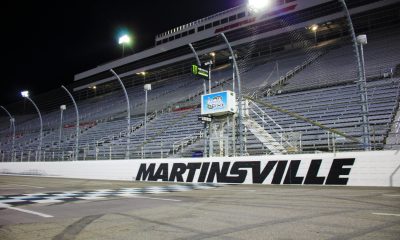
A tire blowout was not the cause of Justin Carroll’s accident at Dominion Raceway on September 3rd, American Racer said following a thorough investigation.
American Racer’s analysis, which was released on their website earlier this afternoon, found that Carroll started the race below the recommended minimum air pressure of 23-25 psi and discovered that the suspension was dragging on his car.
“If you look at it, it’s one of two things that could have happened,” Scott Junod, director of racing for American Racer said. “Neither of the two are a defective product that would have caused it.”
The most likely scenario is that the suspension actually broke on Justin Carroll’s car, sending him careening into the wall
“The suspension we think probably broke and it might have happened so quickly that Justin may not have known the difference at that point. There wasn’t a whole lot of time between when he veered off course and hit the wall. That’s less than a second or so.”
American Racer’s investigation found that the tire on Justin Carroll’s car did not come apart prior to impact, however, Junod said he could not conclusively state that a suspension failure caused the problem. Junod notes that he does know Carroll started the race below the recommended minimum air pressure because the team told him so.
“I know they set it before the recommended air pressure because they told me they did,” Junod remarked. “So, they may have believed, they had spoken with some people at the track and they said that they had spoken to a Dominion Raceway official that said 20 pounds of air is fine.”
Junod noted that Carroll did not give a name for who he talked to at Dominion Raceway, but that starting out at 20.5 psi is nothing that he would recommend.
“That’s not anything I would think. I can’t speak to that, but I know what I published back in April that was published on the Dominion website … The only thing I know is what they said they put in their tire. That’s what they told me, 20.5 psi in the right front. So, people don’t really think that extra 3-5 pounds is a big difference. It’s huge in that setting.”
Dominion Raceway ran twin 50 lap features on September 3rd, which compounded the low tire pressure deal since the team was able to reset their tire pressure for the start of the second race. Since the tire cooled down to ambient temperature, this allowed the tire to cycle through the low air pressure stage a second time – potentially doing twice as much damage to the tire as would be done in a normal race.
During the 150 lap race, held on September 8th, teams were allowed to look at the tires during a halfway break but were not allowed to adjust air pressure. There were no documented tire issues in the 150 lap Late Model Stock Car race at Dominion Raceway.
“If you start off at low air pressure in the first race and you survive, you’re going to start in the second race with the same low air pressure so you cycle through the low air pressure phase where it can be damaged twice,” Junod said. “Not the case last week.”
American Racer examined the track surface, which showed cuts to the track from Carroll’s car as well as skid marks, which led them to believe the tire was intact at the time of impact and that the suspension was dragging, causing the crash.
“We know there was something dragging on the ground prior to when Justin said the failure occurred,” Junod explained. “That happened prior to when, he said he was past the apex coming back in the gas coming out of two when all hell broke loose when the failure occurred. There are cuts in the track well before that that are in line with that car and belong to that car. At this point, there is certain amounts of certainty I can say about certain things.
“I can’t tell you for sure when the tire lost air. I’m pretty certain it was past the apex and more likely than not, I believe the tire had air in it all the way until it hit the wall. That’s the more likely than not scenario but it’s not absolute 100 percent. Based on the facts that we see. Based on the skid marks, it cannot be the right rear. The skidmark going all the way to the wall had to be from the right front.”
Teams starting races below the recommended minimum air pressure while racing on American Racer tires was the primary cause of a series of incidents in a CARS Tour race at Orange County Speedway last August. Junod told Short Track Scene that he had pushed for a minimum air pressure rule and enforcement of it prior to the race.
“I tried to get that done on the CARS Tour and I was unsuccessful,” Junod claimed. “They didn’t want to do it. Even after we had tested at Orange County and at Concord, they didn’t want to do it with OCS so I made a deal.
“They said they would publish the recommended minimum air pressure of 25 psi in the right front. And, should they not allow me to enforce it at Concord, if they were not willing to let me enforce a right front pressure rule, I had told the CARS Tour that we would not provide tires for that race. We never got there.”
A couple days after the Orange County race, CARS Tour switched from running American Racer tires to running Hoosier tires. Junod said the decision to switch still bothers him.
“I was at every one of the CARS Tour races, every one that we were supplier,” Junod remarked. “We had very little trouble. You always have somebody that’s pushing the envelope. For 99 percent of the stuff, the guys liked the tire. There were a handful of guys that wanted to change. Does it still bother me that, knowing air pressure was the cause of those failures? Yes, it still bothers me.”
After CARS Tour switched to Hoosier, Carteret County Speedway decided to run on American Racer tires for their inaugural race last September. Carteret has continued racing on the tires with very little incident.
“I think the tires are great,” Carteret County Speedway general manager Roger Burns said. “They run good throughout the whole spectrum of the race. They don’t fall off. We’ve had no problems, just blistering on two out of 400 tires. I love the tires and I think they’re better than Hoosier and I feel American Racer will power through their problem, if one exists.”
Tim Allensworth, who competes regularly at Carteret County Speedway, says the only issue he’s had is with one tire blistering. However, Allensworth said he blames the car setup for that and prefers American Racer tires to their Hoosier counterparts.
“I do like the tire,” Allensworth said. “They repeat better than Hoosier. After 10 laps, they repeat week to week so they make nice practice tires and are a lot more durable than Hoosier. If they do a two new, two scuff deal, that would be more beneficial than Hoosier. Hoosier tires, all the speed is out of them after three or four laps.”
Allensworth prefers the American Racer tires because they’re more consistent and he says he can race longer on them – sentiments that have been echoed by other Carteret County Speedway competitors, including Chris Burns.
“American Racer, you can go a lot harder throughout the race without trying to conserve tires where Hoosier falls off so bad,” Allensworth remarked. “Trying to save your tires until the end of the race, that comes into play on Hoosier. I run as hard as I can for all 60 laps. They don’t give up, that’s why I like them.”
However, Carteret County Speedway and Dominion Raceway, the only asphalt tracks in the Southeast region to run on American Racer tires, are very different. While Carteret is a flat, 4/10-mile oval with wide, sweeping corners similar to Langley Speedway, Dominion Raceway is a high banked 4/10-mile speedplant.
“Carteret is a different animal than Dominion,” Junod explained. “Carteret is a flat track so there’s not high loading on that track. Not like Dominion where you have high bank and you’re carrying a lot more speed and you load the tire. That’s what flexes the carcass. So, you would expect to never have this problem at Carteret but it’s possible at a track as fast and high banked as Dominion.
“That’s a fast track,” Junod continued. “High load. I don’t have the number that the right front sees over 4,000 pounds of downforce in the turns. That’s a lot.”
Because of the differences between the two tracks, American Racer runs different tires at Dominion than at Carteret.
The McCreary branded American Racer tire Dominion runs on is wider, measuring in at 11 inches, to enhance load carrying capability for high load tracks, whereas Carteret County Speedway runs on the tires that were used in the CARS Tour for much of the 2015 season. The tire at Dominion also has a different compound which is designed to run cooler to minimize blistering.
“Anybody can blister anything they want when they want to,” Junod said. “If they’re dirt tracking it, you can blister a right rear. From what we have found from all of our testing is why we developed this particular compound specifically for Dominion.”
Junod plans to use the tire that is run at Dominion Raceway at more racetracks in the future.
“We intend to use it all over the country,” Junod remarked. “We’re testing this in different regions of the country. The construction is slightly different than the CARS tire, the width and compound is different, as much different as you can make a tire. There’s not much to them.”
American Racer has been scrutinized over the safety of their tires in the short track news media as well as social media. However, Junod says no tire is safe if racers and teams don’t follow basic principles, such as starting the tires at the recommended minimum tire pressure.
“No tire is safe if you don’t follow some basics, no tire,” Junod said. “Goodyear, Hoosier, American Racer, doesn’t matter. You have to, there’s a certain amount of responsibility on the teams. We’ve been getting pounded in the media that our tires are deemed to be unsafe. It’s not unsafe. The tire is fine as is evidenced by nearly the entire season on Late Models without any issue. The tire will run there, it’s fine.”
Junod reiterated that the tire that came off Justin Carroll’s car did not disintegrate due to workmanship or material.
“I can unequivocally say that the tire did not fail due to any workmanship or material problem,” Junod commented. “It failed either because of suspension failure or the tire was going to fail in moments anyway due to low air pressure. I can’t fix any of those problems, that’s on the team.”
Justin Carroll responded to the American Racer report by saying the cuts to the track surface noted by Junod were from the sway bar arm dragging. He said the sway bar arm was dragging as a result of a tire failure.
“Reading the article published by American Racer, the scraping marks on the track was from the sway bar arm dragging when the right front tire blew,” Carroll said. “The track suggested to not start the right side tires less than 20 psi and we started at 20.5. Also, they said something about the camber the thread depth from inside to outside of the tire was 5/32 inches even across the tire.”
Carroll plans to seek an independent expert opinion from a third party.
Carroll’s teammate, Maddy Ryan Mulligan, has competed on American Racer tires at Carteret County Speedway and plans to race at Carteret again on September 24th.
Dominion Raceway ran a race on September 9th, just five days after Justin Carroll’s incident, with no documented tire problems during their 150 lap Late Model Stock Car race.
Marquis comes from St. Charles, Maryland and has a widespread background in journalism, having covered politics in Washington and Maryland as well as nearly every form of auto racing, including NASCAR, IndyCar, AMA Motocross and IHRA Drag Racing. Now living near Emerald Isle, North Carolina, Marquis covers Late Model Stock Cars and Super Late Models in the Carolinas and Virginia.